The history of Estepona: from Phoenician port to flower filled coastal town
To really understand Estepona, you need to slow down.
It’s not a place that shows itself all at once. Its story is layered, built quietly over centuries, and you feel it best when you walk its streets without rushing. When you notice how the old town opens up, how the sea is never far away, and how life here feels intentionally human-sized.
Estepona’s charm isn’t accidental. It’s the result of history, geography, and a very conscious choice to protect identity over hype.
Before Estepona had a name
Long before Estepona became a town, this stretch of coastline was already valuable.
Among the earliest known settlers were the Phoenicians, drawn by the favourable stretch of coastline with access to maritime trade. Later, the Romans arrived, leaving behind traces of villas, roads, and fishing settlements. The sea was the lifeline then, just as it is now.
Fishing, salt production, and trade defined life here for centuries. Estepona didn’t grow as a grand city, it grew as a working coastal settlement. Practical and closely tied to nature.
That practical DNA is still visible today.
The Moorish era: foundations of the old town
From the 8th century onward, Estepona became part of Al-Andalus, the Moorish-ruled region of southern Spain. This period shaped the town in ways you can still feel if you know what to look for.
- Narrow streets designed for shade
- Whitewashed walls to reflect heat
- A compact layout that encouraged walking and community
The original settlement was fortified, with watchtowers along the coast to protect against pirates and invasions. These defensive structures remind us that this peaceful place once lived with real uncertainty.
The rhythm of daily life (slow, social, outdoors) comes directly from this era.
Christian reconquest and a town rebuilt
In 1457, Estepona was reconquered by Christian forces under King Henry IV of Castile. Like many Andalusian towns, it went through periods of instability afterward. Attacks from pirates, population decline, and rebuilding efforts.
What makes Estepona different from some neighbouring cities is that it never turned into a grand aristocratic centre. It remained a small, resilient coastal town, rebuilt again and again by people who lived close to the land and sea.
Fishing, agriculture, and craftsmanship continued to define daily life well into the modern era.
A long time without tourism
For much of the 19th and early 20th centuries, Estepona existed quietly outside the spotlight.
While other parts of the Costa del Sol later exploded into mass tourism, Estepona stayed relatively untouched. It was poorer, yes but it also preserved its scale, traditions, and social fabric.
This “late arrival” to tourism would eventually become one of its greatest strengths.
The modern turning point: choosing identity over excess
In the late 20th and early 21st century, Estepona faced the same choice as many coastal towns: grow fast, or grow thoughtfully.
Estepona chose thoughtfully.
Instead of building a skyline of high-rises, the town invested heavily in:
- restoring the old town
- pedestrianising streets
- planting thousands of flowers and trees
- commissioning large-scale murals and public art
- improving walkability and public spaces
This transformation gave birth to the nickname “The Garden of the Costa del Sol.” But more importantly, it created a town that feels lived in, not staged.
Why Estepona feels different today
When people visit Estepona for the first time, they often struggle to explain why it feels so pleasant. The reason lies in its history.
Estepona was never designed to impress, it was designed to function. And now, with care and vision, that functionality has been turned into beauty.
You notice it in:
- the absence of rush
- the way locals use public space
- the fact that evenings belong to walking, not rushing
- the balance between sea, town, and mountains
It’s a place where daily life still matters.
Experiencing history the right way
The best way to experience Estepona’s history isn’t through a museum checklist, it’s through pace.
- Walk the old town early in the morning
- Notice how streets open into small squares
- Sit down for coffee without checking the time
- Walk to the sea and follow the promenade
- Watch the town shift from day to evening
History here isn’t behind glass. It’s alive.
Why staying near Estepona makes sense
Estepona is a town you want to visit slowly. And that’s why where you stay matters.
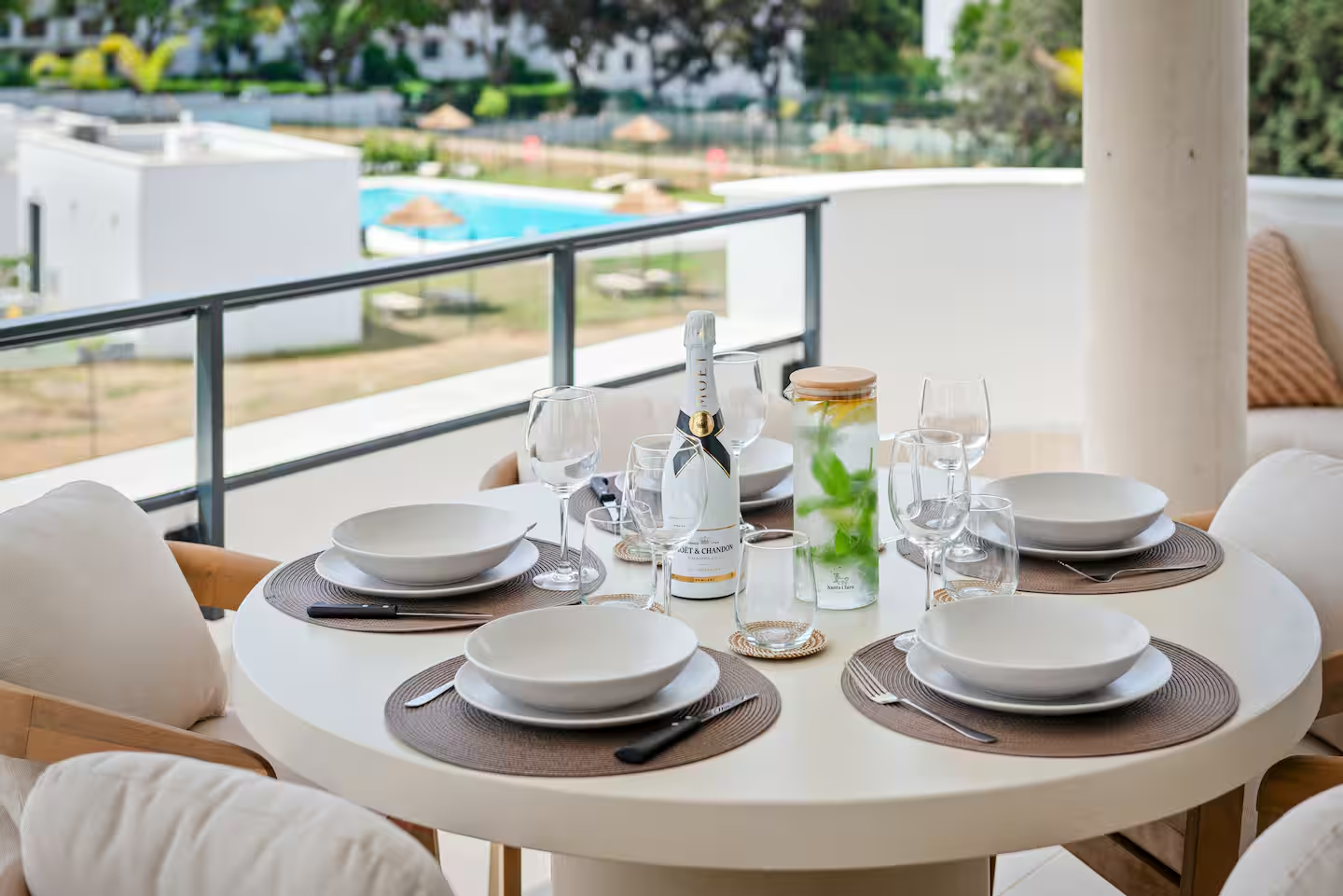
Casa Calma sits close enough to explore Estepona easily but far enough to return to peace, space, and comfort. After wandering streets shaped by centuries of history, you come home to a place designed for rest, reflection, and modern comfort.
If you’re drawn to places with depth, character, and a sense of continuity... Estepona delivers. And if you want to experience it without rushing, crowds, or noise, Casa Calma is the kind of base that lets the town reveal itself naturally.
Book Casa Calma and experience Estepona, the garden of the Costa del Sol, at your own pace.